California Senate Bill 1454: Impact on Houses of Worship Volunteer Security Programs
A Strategic Guide to the 2029 Sunset Review Window
What SB 1454 Changed for Houses of Worship
On September 22, 2024, Governor Newsom signed SB 1454 into law as part of the Bureau of Security and Investigative Services (BSIS) sunset review. The bill took effect January 1, 2025. While the bill’s primary purpose was extending the BSIS’s regulatory authority, it contained a significant change that directly affects houses of worship: the removal of the long-standing exemption that had allowed charitable and philanthropic organizations—including churches, synagogues, mosques, temples, and other religious institutions—to operate volunteer security programs outside of state regulation under the Proprietary Security Services Act.
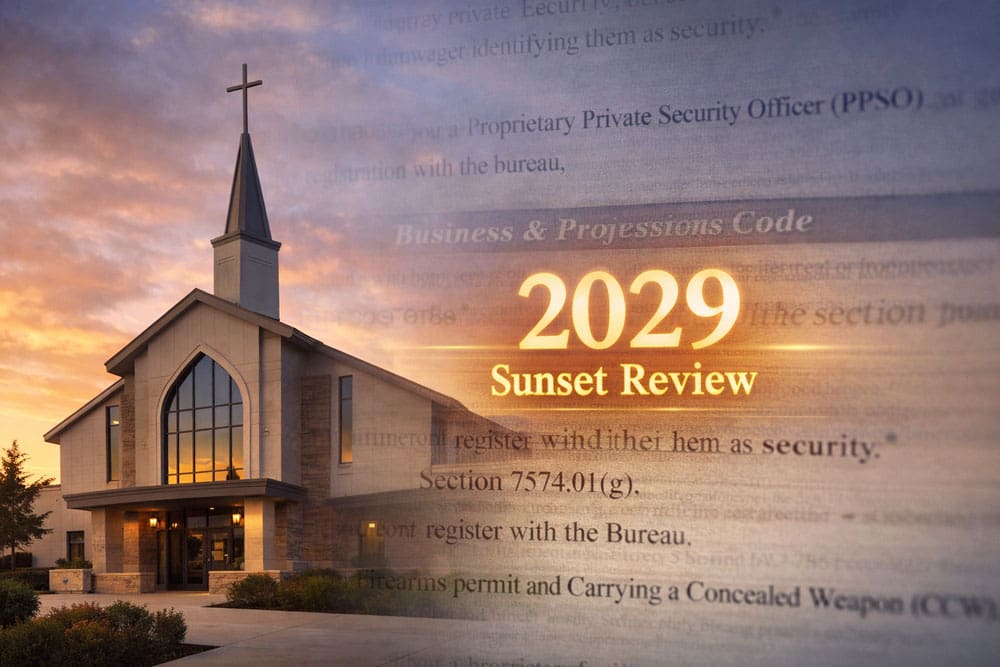
Under the prior law, houses of worship could designate congregants as volunteer security without triggering BSIS licensing or registration requirements. SB 1454 eliminated this carve-out. Now, under Business and Professions Code § 7574.01(g), any individual—paid or volunteer—who wears a distinctive uniform identifying them as a security officer and is likely to interact with the public may be classified as a Proprietary Private Security Officer (PPSO) and must register with the BSIS, complete state-mandated training, and comply with regulatory oversight.
Religious organizations are not listed among the exemptions under Section 7582.2 of the Business and Professions Code.
What Triggers BSIS Regulatory Oversight
Under the current statutory framework, BSIS oversight is triggered when a house of worship’s security volunteers meet certain functional criteria. The following activities bring volunteer personnel within the scope of BSIS regulation:
- Marketing or introducing personnel to the congregation or public as “security”
- Requiring uniforms, tactical gear, or law enforcement-style attire that identifies them as security officers
- Compensating volunteers (even indirectly) for protective duties
- Directing volunteers to patrol, confront, detain, or use force
- Allowing volunteers to carry weapons or defensive tools such as batons, tasers, or firearms
For armed security—whether paid or volunteer—the requirements are more stringent. Armed officers must obtain a Private Patrol Operator (PPO) license, a BSIS firearms permit, and a Carrying a Concealed Weapon (CCW) permit. Practically speaking, this means most houses of worship cannot field armed volunteer security without contracting with or operating through a licensed PPO.
The January 1, 2029 Sunset Review: What It Means
SB 1454 extended the BSIS’s regulatory authority under the Private Security Services Act (Business and Professions Code § 7576) with a sunset review date of January 1, 2029. The operative statutory language provides that the Bureau’s powers and duties shall be subject to review “as if this chapter were scheduled to be repealed as of January 1, 2029.”
This is the most operationally significant date for houses of worship seeking to challenge or modify SB 1454’s impact. The sunset review is a mandatory process under California’s Joint Legislative Sunset Review Committee framework. Before the January 1, 2029 date, the Legislature must act—either extending, modifying, or allowing the repeal of the BSIS’s regulatory authority over private security. If the Legislature takes no action, the relevant chapters of the Business and Professions Code are automatically repealed.
How the Sunset Review Process Works
The sunset review follows a structured process with specific milestones:
- BSIS Report Submission (by December 1, 2027). The Bureau must submit a comprehensive report to the Joint Legislative Sunset Review Committee covering its operations, enforcement actions, licensing data, and any issues identified since the last review. This report is a public document.
- Legislative Background Papers (early–mid 2028). The Assembly Committee on Business and Professions and the Senate Committee on Business, Professions and Economic Development prepare background papers that analyze the Bureau’s report, identify issues, and pose questions for the hearing.
- Joint Sunset Review Hearing (2028). A public hearing where BSIS leadership presents, committee members ask questions, and—critically—stakeholders may provide public testimony. This is the formal opportunity for houses of worship to voice concerns on the record.
- Sunset Legislation (2028–2029 session). Following the hearing, the Legislature introduces a sunset bill that either extends the Bureau’s authority (with or without modifications) or allows it to lapse. Amendments to the sunset bill—including new exemptions—can be introduced during this window.
Strategic Windows for Advocacy
Houses of worship and their advocacy organizations have three distinct windows to seek legislative relief. Each has different advantages and requires different preparation.
Window 1: Standalone Exemption Bill (2026–2028)
A legislator may introduce a standalone bill at any time to amend the Business and Professions Code to create a specific exemption for houses of worship under Section 7582.2. This can be attempted in the current 2025–2026 session or the 2027–2028 session. This approach does not require waiting for the sunset review, but it does require a legislative sponsor willing to author the bill and sufficient political support to move it through committee. The advantage is speed and directness. The disadvantage is that standalone bills face higher scrutiny because they are not part of a broader reauthorization package, and the BSIS and labor stakeholders may actively oppose a carve-out.
Window 2: The Sunset Review Hearing (2028)
This is the single most strategic opportunity. The sunset review hearing is the formally designated moment when the Legislature evaluates whether the BSIS’s regulatory framework is working as intended. The committees explicitly invite stakeholder testimony. Houses of worship can present evidence that the removal of the prior exemption has created undue burden—financial, operational, or practical—without a corresponding public safety benefit. Because the Legislature must act on the sunset bill regardless, amendments to carve out a religious organization exemption can be attached to the reauthorization legislation. This is politically easier than a standalone bill because the vehicle (the sunset extension) already exists and must pass.
Window 3: Amendment to the Sunset Bill (2028–2029)
After the sunset hearing, the committees draft the sunset extension bill. During the bill’s journey through committee markup, floor votes, and conference, amendments can be proposed. This is the final legislative window before the January 1, 2029 deadline. Advocacy organizations that have already participated in the hearing and built relationships with committee members are best positioned to influence amendments at this stage.
Building the Case for an Exemption
Any effort to secure a legislative exemption must be grounded in a substantive, evidence-based argument. The following areas should form the core of the advocacy strategy:
Demonstrating the Burden
Houses of worship should document the concrete costs and operational challenges created by BSIS compliance: registration fees per volunteer, mandatory training hours, administrative paperwork, and the effect on volunteer recruitment and retention. Smaller congregations with limited budgets are disproportionately affected. Collecting this data across multiple denominations and geographic regions strengthens the case.
Public Safety Record
If volunteer safety teams at houses of worship have operated for years with a strong safety record and minimal incidents, that data is powerful. Legislators will want to know whether the exemption created a measurable public safety problem—or whether its removal is a regulatory overreach that solves a problem that does not exist.
Constitutional Considerations
While SB 1454 is a facially neutral law of general applicability, advocacy groups may argue that its practical effect disproportionately burdens the free exercise of religion by imposing state licensing requirements on internal safety ministries. This argument is stronger when framed alongside the Religious Freedom Restoration Act (RFRA) principles at the federal level and Article I, Section 4 of the California Constitution, which guarantees free exercise of religion. Legal counsel should evaluate whether a tailored exemption can be drafted that satisfies both public safety interests and religious liberty concerns.
Coalition Building
An exemption effort is far more likely to succeed if it is presented as a broad, interfaith coalition request rather than a single-denomination initiative. Engaging organizations across the religious spectrum—Christian, Jewish, Muslim, Sikh, Hindu, Buddhist, and others—demonstrates that the issue is not partisan or sectarian, but a shared concern about regulatory overreach affecting faith communities statewide.
Recommended Action Timeline
| Timeframe | Recommended Action |
| 2026 | Begin building an interfaith coalition. Identify a legislative sponsor. Engage legal counsel to draft proposed exemption language for Section 7582.2. Document compliance costs and burdens. |
| Early 2027 | If pursuing a standalone bill, have it introduced in the 2027–2028 legislative session. Begin outreach to Assembly Business and Professions Committee and Senate Business, Professions and Economic Development Committee members. |
| Dec. 1, 2027 | BSIS submits its sunset review report. Obtain and review this report for data on enforcement actions against houses of worship and any BSIS recommendations. |
| Early–Mid 2028 | Legislative committees publish background papers. Submit written comments and request inclusion of house-of-worship concerns in the background paper’s issue list. |
| 2028 (Hearing) | Provide testimony at the Joint Sunset Review hearing. Present coalition statement, data on burden, safety record, and proposed exemption language. |
| 2028–2029 | Advocate for amendments to the sunset extension bill that include a house-of-worship exemption under Section 7582.2. Maintain contact with committee staff throughout markup. |
| Before Jan. 1, 2029 | If no exemption is obtained, evaluate alternative compliance strategies or potential legal challenges. |
Related Legislation in the 2025–2026 Session
While no bill has been introduced in the current session to specifically amend SB 1454’s treatment of houses of worship, two related bills demonstrate legislative interest in protecting religious institutions. AB 2664 (introduced February 2026) addresses unlawful activities near places of religious worship, prohibiting harassment and intimidation within 100 feet of entrances. SB 1070 (authored by Senator Shannon Grove) strengthens Penal Code § 302 penalties for disrupting religious worship services, creating a “wobbler” offense allowing felony prosecution. These bills signal that the Legislature is receptive to faith-community safety concerns—a political environment that could support an SB 1454 exemption effort.
Important Considerations
This guide is provided for informational and strategic planning purposes only and does not constitute legal advice. Houses of worship considering a legislative challenge or exemption effort should retain qualified legal counsel experienced in California administrative law, legislative advocacy, and religious liberty issues. The sunset review process involves political considerations that extend beyond statutory language, and effective advocacy requires relationships with committee members and staff that must be cultivated well in advance of the hearing.
Organizations should also be aware that while the sunset review creates a window of opportunity, there is no guarantee that the Legislature will be receptive to an exemption. The BSIS, organized labor, and public safety advocates may oppose carve-outs on the grounds that they create regulatory gaps. Any exemption proposal must be carefully drafted to address legitimate public safety concerns, for example, by requiring minimum training standards for volunteer safety teams even if full BSIS registration is not required.
Key Legislative References
Business and Professions Code §§ 7574.01, 7576, 7582.2 | SB 1454 (Chapter 588, Statutes of 2024)
Sunset Review: Joint Legislative Sunset Review Committee | Sunset Date: January 1, 2029