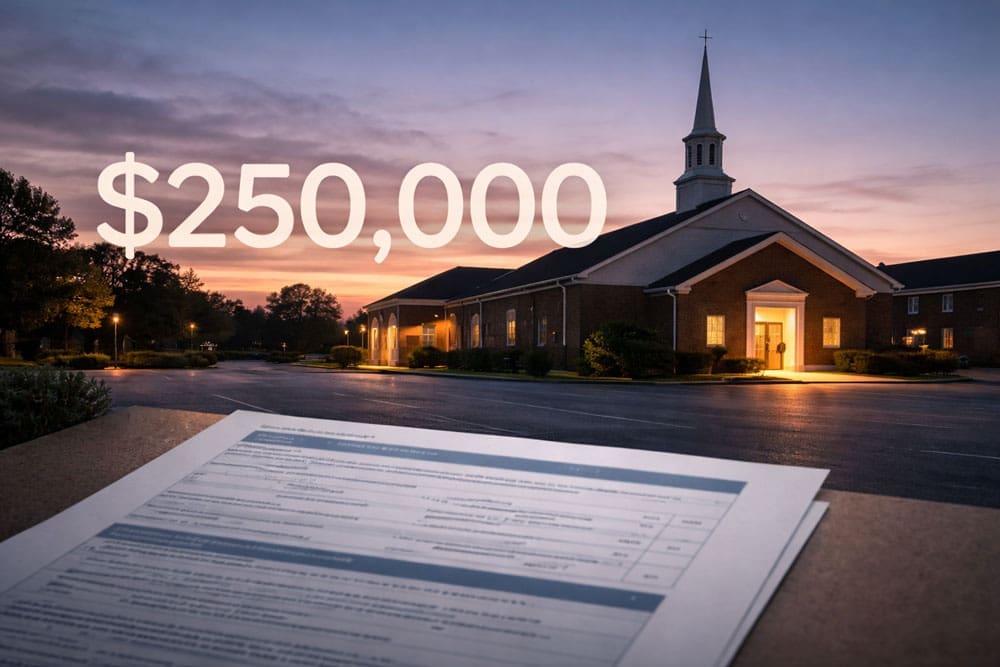
Is Your House of Worship Leaving $250,000 on the Table?
California’s state-funded nonprofit security grant program is one of the most generous in the nation — and most eligible organizations never apply. Here is what you need to know, and how Kearnan Consulting Group, LLC can guide you through every step.
KEY FIGURES AT A GLANCE
| $76M CA CSNSGP Allocation 2025–26 | $250K Max per Location (CSNSGP) | $500K Max per Org (2 Sites) | $150K Federal NSGP per Site | 48 pts Scoring Scale (40+ competitive) |
The Threat Is Real — So Is the Funding
Across California, houses of worship, faith-based social service agencies, Jewish community centers, mosques, churches, and other nonprofit organizations face a sobering reality: hate crimes and targeted attacks on faith communities have risen sharply in recent years. The FBI and California Department of Justice consistently rank houses of worship among the highest-risk targets for religiously motivated violence.
The good news is that California and the federal government recognize this threat — and have created two complementary grant programs to help nonprofits harden their facilities, train their staff, and build security plans. The challenge is that these programs are competitive, documentation-heavy, and unfamiliar territory for most organizations. That is precisely where Kearnan Consulting Group, LLC comes in.
“You do not need to navigate the vulnerability assessment process or the grant application alone. Our team exists to do exactly that work — so your leadership can stay focused on your mission.”
Two Programs, Two Opportunities
CALIFORNIA STATE NONPROFIT SECURITY GRANT PROGRAM (CSNSGP)
The CSNSGP is California’s own state-funded program, administered by the California Governor’s Office of Emergency Services (Cal OES). For the 2025–26 cycle, California allocated $76 million to this program — one of the largest state-level nonprofit security grant pools in the country.
Awards are distributed on a competitive, points-based basis. Cal OES funds the highest-scoring proposals until the full $76 million is exhausted. Awards are given per physical location, making this especially valuable for organizations with multiple facilities.
Maximum awards under CSNSGP:
✓ Up to $250,000 per location (CSNSGP)
✓ Up to $500,000 per organization across two locations
✓ Up to $500,000 for Support Services applicants
FEDERAL NONPROFIT SECURITY GRANT PROGRAM (NSGP)
Administered by FEMA, the NSGP runs parallel to the state program. It offers up to $150,000 per site, with organizations potentially receiving up to $450,000 across three sites. The federal program is divided into two tracks — NSGP-Urban Area (for nonprofits in designated urban areas) and NSGP-State (for nonprofits in non-urban areas).
Importantly, organizations can apply to both the state and federal programs simultaneously, potentially stacking awards for the same location and significantly increasing their total security investment.
Important distinction: Unlike the federal program, California does not use the term “NOFO” (Notice of Funding Opportunity). Cal OES issues a Request for Proposals (RFP) each year, administered through the Cal OES Infrastructure Protection Grants Unit. The RFP includes program rules and regulations, the application form, a vulnerability assessment worksheet, and any addenda or clarifications. Applicants searching for CSNSGP materials should look for the RFP — not a NOFO — on the Cal OES website.
WHAT YOUR GRANT DOLLARS CAN FUND
| Physical security upgrades: cameras, access control, alarms, reinforced doors, fencing, and lighting |
| Security planning: formal security plans, emergency procedures, and evacuation protocols tailored to your congregation |
| Staff & volunteer training: threat recognition, active threat response, and bystander intervention training |
| Construction / renovation: target-hardening improvements, typically up to $100,000 within the award |
| Contract security services: allowable up to approximately 50% of the total request |
Who Is Eligible? A Note for Houses of Worship
One of the most important — and least understood — aspects of the CSNSGP is its treatment of houses of worship. Churches, mosques, synagogues, gurdwaras, and other religious congregations do not need a formal IRS 501(c)(3) determination letter to apply. If your organization meets the substantive requirements of 501(c)(3), you may be eligible — even without the formal designation.
Core eligibility checklist:
✓ Organized as a nonprofit consistent with IRC §501(c)(3), or a qualifying house of worship
✓ Physically occupying the site at time of application (no vacant lots or active construction sites)
✓ At high risk for violent attacks or hate crimes based on ideology, beliefs, or mission
✓ Located in California
✓ Applying for no more than two distinct physical locations
✓ Not a for-profit entity or a fundraising arm of a qualifying organization
The risk nexus requirement deserves special attention. Your application must clearly articulate why your organization faces elevated risk — not simply that crime exists in your neighborhood. Documented incidents, threats, vandalism, or your organization’s public profile as a faith community are all relevant. This is where a well-crafted narrative, supported by a professional vulnerability assessment, makes or breaks an application.
Understanding the Scoring Process
The CSNSGP uses a 48-point competitive scoring scale. Practitioners generally consider a score of 40 or above necessary to be competitive for funding. The scoring criteria reward specificity, documentation, and alignment between the identified threats and the proposed security measures.
| Scoring Criterion | Weight | KCG Focus |
| Threat & vulnerability articulation (VA worksheet quality) | Highest | VA Authorship |
| Risk nexus to ideology / mission with documented evidence | Highest | Narrative Writing |
| Project design & alignment to identified vulnerabilities | High | Proposal Design |
| Feasibility & budget clarity | Medium | Budget Build |
| Documentation compliance (forms, naming, certifications) | Moderate | Compliance Review |
The single largest driver of a strong application is the Vulnerability Assessment (VA) worksheet. Cal OES requires a current, site-specific vulnerability assessment completed before the application is submitted. This document — when done properly — tells the story of your organization’s specific risk environment, existing security measures, and identified gaps. It is the evidentiary foundation upon which the entire application rests.
Kearnan Consulting Group, LLC conducts professional vulnerability assessments that meet Cal OES and FEMA standards. Our assessors are trained and credentialed to produce the documentation that evaluators score — not generic checklists, but site-specific, threat-informed analyses that give your application the strongest possible foundation.
The 2025–26 Application Timeline
The window to apply is narrow. Understanding the timeline is essential to positioning your organization for success in the current cycle and planning ahead for future cycles.
| Phase | Date / Window | Notes |
| RFP Released | 2025 | Cal OES posts RFP, forms, and VA worksheet requirements |
| Standard Application Deadline | Dec 12, 2025 | Main deadline for most applicants |
| Support Services Deadline | Jan 12, 2026 | Extended deadline for Support Services track only |
| State Review & Scoring | Winter 2025 – Early 2026 | Cal OES ranks and funds top proposals until $76M is exhausted |
| Award Announcements | Early 2026 | Subawards issued following scoring and budget approvals |
| Period of Performance | Mar 1, 2026 – Dec 31, 2027 | Reimbursement-based; all work must occur within this window |
Note: Deadlines above reflect the 2025–26 cycle. Future cycles will be announced by Cal OES. Organizations that missed the current window should begin preparation immediately for the next cycle.
⚠ CRITICAL PLANNING ALERT
⚠KCG, LLC typically closes its client roster months before each application deadline. If you are not in the queue, you may not be served. Start today.
Don’t Wait — Start Preparing for the 2027 Application Cycle Now
The 2025–26 cycle is either underway or recently closed for most applicants. But the next application window — the 2026–27 cycle — will arrive faster than most organizations expect. Based on the established pattern of prior years, the projected timeline for the next cycle is as follows.
PROJECTED 2026–27 CYCLE TIMELINE
| Phase | Date / Window | Notes |
| Projected RFP Release | Late Summer / Fall 2026 | Based on prior-year Cal OES posting patterns; watch for official announcement |
| Projected Application Deadline | Est. Nov–Dec 2026 | Estimated based on 2025–26 precedent; expect a Dec 2026 cutoff |
| Vulnerability Assessments Should Be Complete | By Oct 2026 at latest | VA must precede application; scheduling now avoids last-minute conflicts |
| KCG, LLC Client Roster Closes | Typically 2 months prior | KCG stops accepting new clients well before the deadline due to volume; engage now |
| Projected Award Period of Performance | Est. 2027–2028 | Security improvements funded must be implemented within the POP window |
All 2026–27 cycle dates are projections based on established Cal OES and FEMA patterns. Confirm with official announcements from Cal OES and FEMA when released.
WHY YOU MUST ACT NOW — THREE CRITICAL STEPS
STEP 1: SCHEDULE YOUR VULNERABILITY ASSESSMENT IMMEDIATELY
The Vulnerability Assessment is not a formality — it is the cornerstone of your entire application. Cal OES requires a current, site-specific VA completed by a qualified professional before you can submit a competitive proposal. A VA takes time to schedule, conduct, analyze, and format into the required documentation.
Organizations that wait until the RFP is released in late 2026 to begin their VA risk running out of time entirely. Assessor schedules fill quickly once the grant cycle opens. Kearnan Consulting Group, LLC accepts VA engagements year-round precisely so that clients are not scrambling when deadlines approach.
Free resource: CISA (the Cybersecurity and Infrastructure Security Agency) offers free self-assessment tools specifically designed for houses of worship and nonprofits. These tools can help your organization begin identifying vulnerabilities before a professional assessment is conducted. Visit cisa.gov/houses-of-worship to access these resources. Note that CISA tools are a starting point — a professional, site-specific VA from KCG remains required for a competitive CSNSGP application.
► VAs conducted too close to the deadline may not meet the “current” threshold required by Cal OES
► High-quality VA documentation requires revision cycles — not a single site visit
► KCG’s VA calendar fills well in advance of each cycle; scheduling now ensures your slot
STEP 2: RETAIN YOUR GRANT WRITER BEFORE THE RUSH
A professionally written application is the difference between a funded award and a well-intentioned rejection. Experienced nonprofit security grant writers are in short supply, and the best firms are retained by clients who plan ahead.
Kearnan Consulting Group, LLC provides end-to-end grant writing services — from narrative development and budget structuring to final compliance review. Our writers are specialists in CSNSGP and federal NSGP requirements, and they work in close coordination with our administrator or fiscal team so that your application is internally consistent and strategically framed.
► 3 to 4 months before the application deadline: KCG typically stops accepting new grant-writing clients
► Organizations that contact us after our roster closes cannot be served in that cycle
► Starting the grant-writing relationship early allows for stronger narrative development, community input, and multiple review cycles
STEP 3: USE DISCRETIONARY TIME STRATEGICALLY
The months between now and the opening of the next grant cycle are not idle time — they are your competitive advantage. Organizations that use this period intentionally arrive at the application window with stronger documentation, clearer project scopes, and better cost estimates than those who begin at the last minute.
High-value activities to complete now:
✓ Collect and organize incident reports, threat documentation, and law enforcement communications related to your facility
✓ Obtain contractor bids or cost estimates for priority security improvements
✓ Engage your board and leadership in reviewing your current security posture and approving a security improvement plan
✓ Review your organization’s 501(c)(3) documentation and confirm eligibility under program criteria
✓ Identify and document your two priority locations if applying for multiple sites
✓ Begin the KCG engagement process so our VA and writing teams understand your facility, mission, and threat environment well before the clock starts
“The organizations that receive the highest scores are rarely those with the most sophisticated security programs — they are the ones who started the process earliest and documented their case most thoroughly.”
Why Professional Support Matters
These grant programs were designed to be accessible to nonprofits of all sizes — but in practice, the application requirements are demanding. Organizations that submit generic or poorly documented applications are routinely outscored by those that invest in professional preparation.
The most common reasons well-intentioned applications fall short:
✓ The VA worksheet is generic, not site-specific, or completed by an unqualified preparer
✓ The risk narrative does not clearly connect the organization’s ideology or mission to documented threats
✓ The project budget is inconsistent with identified vulnerabilities or contains unallowable costs
✓ Required documentation (forms, certifications, naming conventions) is incomplete or incorrect
✓ Proposed security measures do not clearly address the stated gaps from the VA
Kearnan Consulting Group, LLC addresses every one of these failure points. We conduct the vulnerability assessment, draft the narrative, structure the budget, compile the documentation, and review the final package for compliance — so that the application your organization submits reflects the full strength of your case.
A $250,000 grant award dwarfs the cost of professional preparation. The question is not whether to invest in professional support — the question is whether your application will score high enough to be funded. KCG exists to make sure it does.
Next Steps for Your Organization
Whether you are a congregation of 100 families or a regional social services network serving thousands, the process starts with a conversation. Kearnan Consulting Group, LLC offers an initial consultation to assess your organization’s eligibility, discuss your security concerns, and outline a realistic path to a competitive grant application.
We serve nonprofits and houses of worship across California, and we understand the unique security environments and community dynamics that faith-based organizations navigate. Our work is confidential, professional, and — above all — mission-driven.
Do not let another grant cycle pass without acting. KCG’s client roster for the 2026–27 cycle will fill well before the deadline. Reach out today to reserve your engagement and begin building the strongest possible application.
| READY TO PROTECT YOUR COMMUNITY? Schedule a no-obligation consultation. We will assess your eligibility, answer your questions, and outline the path forward — for the current cycle and the one ahead. Kearnan Consulting Group, LLC Security Consulting · Vulnerability Assessments · Grant Writing Contact Us Now |
OFFICIAL RESOURCES
The following resources are maintained by Cal OES and FEMA and should be monitored for official announcements, RFP releases, and updated guidance:
Cal OES Infrastructure Protection Grants: caloes.ca.gov – Infrastructure Protection Grants
CSNSGP Grant Announcements: caloes.ca.gov – CSNSGP Announcements
FEMA Nonprofit Security Grant Program (Federal): fema.gov – Nonprofit Security Grant Program
CISA Houses of Worship Resources: cisa.gov/houses-of-worship
This advisory is intended for informational purposes only. Grant program details, deadlines, and award amounts are subject to change by Cal OES and FEMA. All 2026–27 cycle dates are projections based on prior-year patterns. Contact Kearnan Consulting Group, LLC for current program guidance.