A guide for church leaders responsible for the safety of children entrusted to their care
Published by Kearnan Consulting Group, LLC, in collaboration with Church Security Solutions
Introduction
A volunteer recently described her concern this way. On any given Sunday his church welcomes about seventy children into its Children’s Ministry, from infants in the nursery to upper-elementary students in classrooms. The leaders had begun to ask the question that every honest church leader has to ask sooner or later. Are we doing enough to keep them safe or How do we keep them safe?
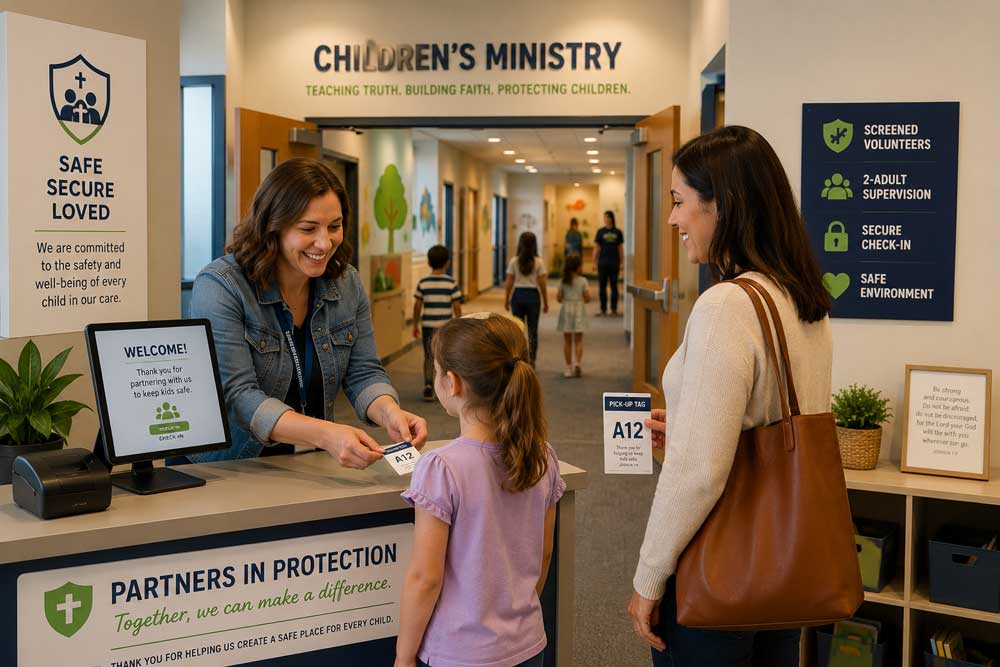
The question is the right one. In our prior articles we have addressed congregational risk management, public-facing safety planning, summer youth camp legislation, and the spiritual and legal foundations for watchful, welcoming ministry. This article narrows the lens to one population, the children, and to the rooms where they gather each week.
Two things should be said at the outset. First, child safety is stewardship, the same stewardship the church already exercises over its finances, its facilities, and its teaching. Second, the threats are real and well documented. According to data published by faith-based insurers, allegations of child sexual abuse remain among the leading reasons that ministries end up in court, and religious institutions consistently rank among the top settings for child sexual abuse insurance losses, second only to elementary and secondary schools in some carrier portfolios. The question for a church with seventy children every Sunday is not whether to build a child protection program, but how good that program is, and whether it would withstand scrutiny if something went wrong.
What follows is a practical framework covering the four areas every Children’s Ministry leader should be able to speak to with confidence: screening, supervision, controlled access, and emergency response.
I. Begin With Governance and a Written Child Protection Policy
Before discussing background checks or check-in software, the board or governing body of the church should formally adopt a written child protection policy. This is not a binder you buy. It is a document the leadership reads, debates, edits, and adopts in a recorded meeting, then reviews annually and after any meaningful change in operations, facilities, or law.
A defensible policy contains, at minimum, the following elements:
- A clear statement of purpose and the church’s commitment to the safety of children.
- A definition of who is covered (paid staff, regular and occasional volunteers, contractors, and anyone with foreseeable contact with minors).
- Screening standards, including written application, references, interview, and background checks.
- Supervision standards, including the two-adult rule and adult-to-child ratios.
- Check-in, check-out, and access control procedures.
- Behavioral expectations, including prohibited conduct, physical-contact guidelines, and restroom and diapering protocols.
- Mandatory reporter responsibilities under applicable state law.
- An incident reporting and response protocol.
- An emergency response section addressing fire, severe weather, medical events, lost or missing child, and active threat scenarios.
- A training requirement, with frequency and documentation standards.
- A statement that the policy has been adopted by the governing body and the date of adoption.
Insurance carriers, plaintiffs’ counsel, and regulators all look first at governance. A board that has read, questioned, and adopted the policy is a board exercising its fiduciary responsibility. A church without a written policy, or with a policy nobody can find, has a problem long before the first incident occurs.
II. Screening: Build the Wall at the Front Door
The most effective child protection happens before the first day of service. Screening is how a church communicates to the broader community, and especially to anyone with predatory intent, that this is not an easy environment to operate in.
The Six-Month Rule
A widely recognized best practice, recommended by Brotherhood Mutual and other faith-based insurers, is that prospective volunteers attend the church for at least six months before being permitted to serve with children. The logic is straightforward. People who intend to harm children typically seek quick, easy access. A required period of observable participation in the congregation is a barrier that most predators are unwilling to cross. They tend to move on to places where access is faster.
A Standardized Application and Personal Interview
Every prospective worker, paid or volunteer, should complete a written application covering prior addresses, prior employment, prior volunteer service with minors, disclosure of any criminal history or prior accusation involving minors, and consent to a background check. A personal interview should follow, conducted by a designated leader trained to ask careful, non-leading questions about the applicant’s experience with children, motivations for volunteering, and understanding of appropriate boundaries.
References
Brotherhood Mutual recommends obtaining at least two references from every applicant, and verifying that at least two of those references are actually contacted. References should come from people who have observed the applicant interact with minors, not only personal friends. The notes from each call should be retained in the applicant’s file.
Criminal Background Checks and Sex Offender Registry Verification
Every worker should undergo a criminal background check that includes national and county-level criminal history and a national sex offender registry search. Single-jurisdiction checks are not sufficient, because predators relocate. Background checks should be repeated on a recurring cycle, with annual rechecks recommended for anyone in regular contact with minors. Ministry-focused screening providers such as those affiliated with MinistrySafe and the major faith-based insurers offer products designed for this purpose.
Annual Training
Every worker should complete annual child protection training covering grooming behavior, signs of abuse, the church’s child protection policy, mandatory reporting obligations under applicable state law, and the specific procedures of the Children’s Ministry. Document each session with date, topic, instructor, attendance, and signed acknowledgment. Training that is not documented effectively did not happen.
III. Supervision: The Two-Adult Rule and Appropriate Ratios
Once a worker is on the team, supervision is the next layer of protection.
The Two-Adult Rule
The two-adult rule is the single most important supervision standard in any Children’s Ministry. No paid or volunteer worker should ever be alone with a child or a group of children. Two unrelated adults should be present in every classroom, every transport vehicle, and every off-site activity. The rule protects children from harm, and it protects workers from the false accusations that occasionally arise even in faithful ministry settings. Many faith-based insurance policies now require the two-adult rule as a condition of coverage.
In practice the rule has implications for staffing. If only one worker shows up on a given Sunday morning, the classroom cannot open until a second adult is on site. That reality should be built into your volunteer schedule and your backup roster, not improvised on the morning of the service.
Appropriate Adult-to-Child Ratios
Ratios should reflect the age and developmental stage of the children. Drawing on standards published by the National Association for the Education of Young Children and the recommendations of leading children’s ministry resources, the following ratios are a reasonable baseline for a Sunday morning environment:
- Infants (birth to twelve months): one adult to four infants, with a maximum group size in the low teens.
- Toddlers (twelve to twenty-four months): one adult to five children.
- Two-year-olds: one adult to six children.
- Three-year-olds: one adult to seven children.
- Four- and five-year-olds: one adult to eight children.
- Elementary (kindergarten through grade five): one adult to ten children, with adjustments for activity type.
These are starting points, not ceilings. State childcare licensing rules may impose stricter standards. Where they do, the stricter standard controls. Whenever the planned ratio cannot be maintained because a volunteer is absent, the classroom should either be combined with another supervised classroom or be temporarily closed until coverage is restored.
Line-of-Sight, Restrooms, and Diapering
Classrooms should be configured so that all activity is observable. Where possible, classroom doors should have viewing windows that are kept unobstructed. Restroom escorts should follow a written protocol that maintains visibility and avoids one-on-one situations. Diapering should occur in a designated, observable area, by approved workers only, with a second adult within line of sight.
IV. Check-In, Check-Out, and Controlled Access
The single highest-consequence operational moment in Children’s Ministry is the release of a child at the end of a service. A child handed to the wrong adult is a catastrophe. The systems that prevent that outcome are simple, learnable, and unforgiving when ignored.
A Secure, Matched-Tag Check-In System
The accepted standard for Children’s Ministry check-in is a matched-tag system. At check-in the child receives a name tag printed with a unique alphanumeric security code, and the parent or guardian receives a matching pick-up tag with the same code. The system can be implemented through any of the established church management or check-in platforms, or through a manual system maintained at the check-in station. Whichever method is used, three rules apply:
- The codes must be unique per child per session.
- The codes must be verified at pickup by a worker, not handed back without inspection.
- The system must capture allergy and medical alerts on the child’s tag and on the classroom roster.
Pickup Authorization
The default rule should be that the child is released only to the person who dropped the child off, or to a person previously designated in writing by that parent. Any designated alternate pickup must be at least fourteen years of age and must present the matching pick-up tag. If a parent has lost the tag, the worker should verify identity through government-issued identification and compare it against the registration record before releasing the child.
Custody and Restraining-Order Notations
Registration should ask whether any custody order or restraining order applies, and any such restriction should be flagged in the child’s file and visible to the classroom worker. This is one of the most common gaps we see in church Children’s Ministries. A parent who has been excluded by court order is no less likely to appear at the pickup door. The worker has to know.
Access Control for Children’s Areas
The Children’s Ministry hallway, classrooms, and restrooms should be treated as a controlled environment during programming hours. Access should be limited to checked-in children, approved workers wearing identification, and authorized parents and guardians. Wandering adults should be politely and immediately redirected. Doors to children’s areas should be staffed during transitions and locked or monitored when not in active use. The same culture of hospitality that defines the rest of your campus can be preserved while still maintaining a visible boundary at this hallway.
V. Emergency Response and Active-Threat Procedures
The Children’s Ministry must have its own written emergency procedures, fully integrated with the church-wide emergency operations plan.
Scenario Coverage
The plan should address, at minimum, fire, severe weather, medical emergencies (including pediatric-specific events), a missing or lost child, an unauthorized person on the premises, and active-threat or lockdown scenarios. Each scenario should specify what the worker does, what the lead does, how children are accounted for, how parents are notified, and how the handoff to law enforcement and emergency medical services is conducted.
Lockdown
Every classroom should have a lockdown procedure that workers can execute quickly. The procedure should address securing the door, moving children away from windows and lines of fire, accounting for every child by name against the check-in roster, and maintaining calm. A pre-positioned classroom safety kit, with water, a first aid kit, and a roster clipboard, is a small investment with significant payoff.
Evacuation
Each classroom should have a primary and secondary evacuation route, posted on the wall. Workers should know the assigned muster zone for their classroom and the head-count procedure that will be used. The roster used at check-in is the roster used at the muster zone. Pre-printed copies should travel with the worker, not stay behind in the classroom.
Reunification
Reunification is the controlled process of returning children to their parents after an emergency. It is the inverse of the check-in process and uses the same matched-tag verification. Parents should be told in advance, in writing, where the reunification site is, how it operates, and what identification will be required. A reunification site that is improvised on the day of the emergency will fail.
Drills
Drills should be conducted at least twice a year, with one fire drill and one lockdown or weather drill at a minimum. Drills should be documented. Lessons learned should be reviewed by leadership and incorporated into the plan.
Coordination With Law Enforcement and First Responders
Invite local police and fire agencies to walk the campus and review the plan. Their input on staging areas, response times, and incident command compatibility is invaluable, and the relationship matters when seconds count.
VI. Practical Steps for a Ministry of About Seventy Children
For a church with approximately seventy children on a Sunday morning, the math becomes manageable when the framework is applied deliberately.
- Build a volunteer roster sized to maintain the two-adult rule and age-appropriate ratios across every classroom, with a documented backup list for last-minute absences.
- Complete a full screening file for every worker, with annual rechecks and annual training, and audit the files at least once a year.
- Implement a matched-tag check-in system and train every worker on it. Walk new families through the process during their first visit.
- Treat the Children’s Ministry hallway as a controlled space during service hours. Post a greeter at the entry and route all questions through a single check-in desk.
- Write a Children’s Ministry emergency plan as an annex to the church’s overall emergency operations plan, with classroom-specific procedures, posted maps, and pre-printed rosters.
- Run at least two documented drills per year, debrief them with leadership, and update the plan.
- Bring the policy, staffing plan, screening summary, incident log, and drill records to the governing board at least annually. Risk that is not on the agenda is risk that is not being governed.
VII. A Word to Pastors and Boards
It is tempting to assume that a small or familiar congregation does not need formal systems because everyone knows everyone. Culture is real, and the trust within a healthy congregation is one of its greatest assets. But culture is what the regulars do on a good day. A written, practiced child protection program is what holds when the regulars are not in the building, when a new family visits for the first time, or when a substitute volunteer steps in.
A documented program is also what protects the church when an accusation arises. Whether the accusation is well-founded or false, the file is what answers the question of whether the church exercised reasonable care. An empty file is the most damaging exhibit in any case.
Watchfulness in this area is an act of love. It honors the trust that parents place in the church when they hand a child across the half-door, it honors the volunteers who serve faithfully and deserve the protection that good policy provides, and it honors the calling of the church to be a place where the most vulnerable are safe.
How Kearnan Consulting Group Can Help
Kearnan Consulting Group, LLC, and Church Security Solutions partner with churches and faith-based organizations to design, document, and implement child protection programs that meet or exceed the standards of leading faith-based insurers and applicable state law. Our work for Children’s Ministry includes policy drafting and board adoption support, screening program design, two-adult and ratio implementation, check-in system selection and procedure writing, classroom and hallway access design, emergency operations plan integration, drill design and after-action support, volunteer training delivery, and governance audits.
For a confidential conversation about your Children’s Ministry program, contact us at jeff@kearnanconsulting.com or visit churchsecuritysolutions.org.
About the Author
Jeffrey C. Kearnan is the Principal of Kearnan Consulting Group, LLC, and operates Church Security Solutions, a dedicated practice serving houses of worship. A thirty-year law enforcement veteran, he provides vulnerability assessments, policy development, emergency operations planning, federal and state grant writing, and serves as a premises-liability and excessive-force expert witness. Qualification Snapshot, Jeffrey C. Kearnan
Sources and Verified References
The following resources informed this publication. Each was reviewed for accuracy at the time of publication.
- MinistrySafe, “Five-Part Safety System,” accessed May 2026. Link
- Church Mutual Insurance Company, “MinistrySafe and Abuse Prevention Systems,” accessed May 2026. Link
- GuideOne Insurance, “Daycare and Nursery Safety,” accessed May 2026. Link
- KidCheck, “Classroom Staffing and Ratios,” accessed May 2026. Link
- National Association for the Education of Young Children, accreditation standards and ratio guidance. Link
- Adventist Risk Management, “Child Safety at Church: Policies, Roles, and What to Watch For,” January 2026. Link
- Lewis Center for Church Leadership, “Ten Non-Negotiable Rules for Child Safety in Churches,” accessed May 2026. Link
- Bitner Henry Insurance Group, “Child Sexual Abuse Is the Second Most Frequent Loss at Religious Institutions,” accessed May 2026. Link
- Church Law and Tax, “Does Your Church Have Sexual Abuse Liability Coverage?” accessed May 2026. Link
- Brotherhood Mutual Insurance Company, “Eyes on the Future: Seeing and Protecting Every Child,” safety library, accessed May 2026. Link
- Brotherhood Mutual Insurance Company, “Background Screening Checklist,” accessed May 2026. Link
- Brotherhood Mutual Insurance Company, “Nursery Safety: Choose Volunteers Carefully,” accessed May 2026. Link
- Kearnan Consulting Group, “Watchful and Welcoming: Why Risk Management Belongs in the Mission of the Church,” May 8, 2026. Link
- Kearnan Consulting Group, “Building a Safer Environment,” May 12, 2026. Link
- Kearnan Consulting Group, “Safety Planning Essentials for Summer Youth Camps, Retreats, and Faith-Based Programs,” May 8, 2026. Link
Disclaimer
This article is published by Kearnan Consulting Group, LLC, for informational and educational purposes only. It does not constitute legal advice, and no attorney-client or professional-services relationship is created by its publication or distribution. The information contained herein is based on publicly available standards, regulations, and guidance current as of May 2026 and is subject to change. State childcare licensing rules, mandatory reporting laws, and other applicable requirements vary by jurisdiction. Organizations should consult qualified legal counsel licensed in their jurisdiction for advice regarding state-specific compliance obligations, regulatory interpretation, and risk management. Kearnan Consulting Group expressly disclaims any liability for actions taken or not taken in reliance upon the information contained in this article.